
Control the player from other apps
From 0.7.0, scripts, automation tools and AI agents on your computer can press the controller’s buttons and move its sticks on the stream, while you keep using another app. An agent can, for example, find its way around the PS5’s menus or test a game, and take a picture of the stream window to see what happened. The player window doesn’t need to be in front. This works on a Mac, on Linux and, from 0.8.0, on Windows.
Only your own user account on this computer can send these commands. Nothing reaches the PS5 from another computer, and the commands you send are never saved.
Turn it on
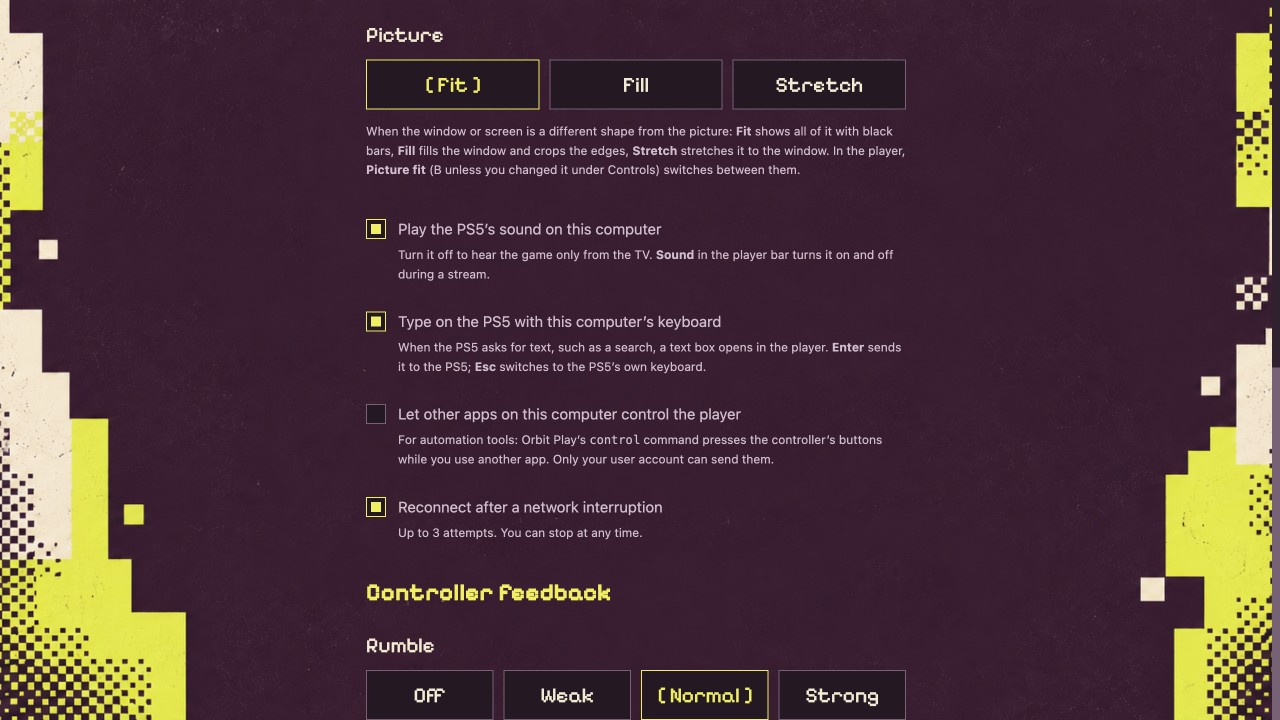
- Open Playback from the main menu, tick Let other apps on this computer control the player, and choose Save playback settings. It’s off until you turn it on.
- Start a stream. The player reads this setting when a stream starts, so stop and start again if a stream was already open.
The command
Orbit Play itself is the command: run it with control first. No other
install is needed.
| Computer | Command |
|---|---|
| Mac | "/Applications/Orbit Play.app/Contents/MacOS/OrbitPlay" control |
| Windows | & "$env:LOCALAPPDATA\Programs\Orbit Play\Orbit Play\OrbitPlay.exe" control in PowerShell (installed with the setup program; from the ZIP, use OrbitPlay.exe in its folder) |
| Linux | /path/to/OrbitPlay-0.8.0-linux-x64.AppImage control (or the arm64 AppImage) |
On Windows the app is a windowed program, so in PowerShell add | Out-String
after a command to see its reply.
The examples below call it orbit-player-control. To use that name on a Mac,
add this line to your shell’s settings:
alias orbit-player-control='"/Applications/Orbit Play.app/Contents/MacOS/OrbitPlay" control'
Choose the PS5
Every command names the folder of the copy of Orbit Play that streams your PS5,
so a command can never press buttons on the wrong console. For the usual copy
that’s ~/Library/Application Support/Orbit Play on a Mac, %APPDATA%\Orbit Play
on Windows and ~/.config/orbit-play on Linux. Set it once in your terminal:
export ORBIT_PLAY_STATE_DIR="$HOME/Library/Application Support/Orbit Play"
In PowerShell on Windows:
$env:ORBIT_PLAY_STATE_DIR = "$env:APPDATA\Orbit Play"
or put --state-dir FOLDER before each command. Without either, the command
refuses with no_ps5_chosen and presses nothing.
Commands
orbit-player-control status                 # is the stream ready, and what is held
orbit-player-control press cross            # one press (100 ms)
orbit-player-control press circle 250       # press for 250 ms, then release
orbit-player-control hold r2 500            # hold for 500 ms, then release
orbit-player-control hold down              # keep held until released
orbit-player-control release all            # let go of everything and centre both sticks
orbit-player-control stick left 0 -1 500    # left stick fully up for 500 ms
- Buttons:
cross,circle,square,triangle,up,down,left,right(the D-pad),l1,r1,l2,r2,l3,r3,options,create,psandtouchpad. - Sticks: x and y go from -1 to 1; for y, -1 is up.
- Times: whole milliseconds, from 1 to 10000.
Each command waits until it has finished, presses included, so commands sent one
after another never run into each other. Use single press commands to move
through menus: a held D-pad direction keeps moving until it’s released. End with
release all when you’re done.
Replies
Each command prints one line and sets its exit status: 0 when it was done, 1 when it was refused, and 2 when no stream is listening.
| Reply | What to do |
|---|---|
{"ok": true} |
Done |
not_running |
Turn the setting on, then start or restart a stream |
no_ps5_chosen |
Set ORBIT_PLAY_STATE_DIR or put --state-dir before the command |
unknown_button |
Use a button name from the list above, such as cross, not x |
bad_duration |
Use whole milliseconds from 1 to 10000 |
rate_limited |
Send fewer than 100 commands a second |
stopped |
The stream ended while the command was running |
status also gives the stream window’s number, so a script can capture just
that window, for example with screencapture -l on a Mac.
Two PS5s at once
One copy of Orbit Play saves several PS5s but streams one at a time, and its commands go to that stream. To stream two PS5s at the same time, start a second copy of Orbit Play with its own folder, pair it with the second PS5 once, and turn on the setting in that copy too:
open -n -a "Orbit Play" --args --state-dir ~/OrbitPlay/ps5-b
Its windows are named after the folder, such as Orbit Play Player · ps5-b.
Commands for that PS5 use --state-dir ~/OrbitPlay/ps5-b. Two copies at once
work at home; away from home, use one at a time.